|
The Prototype
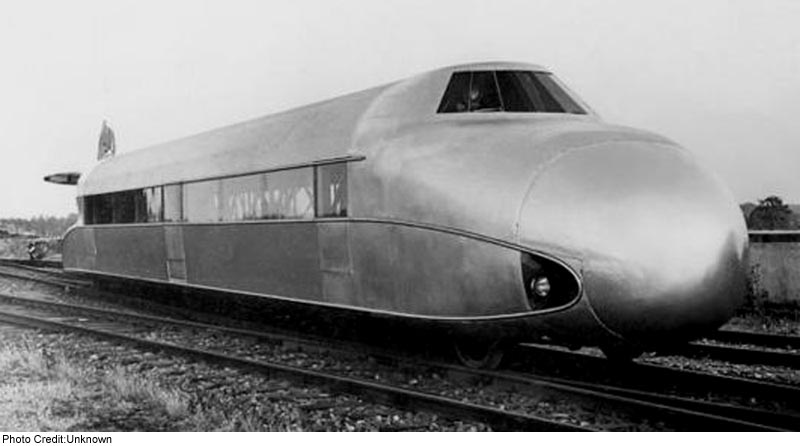
On June 21, 1931, Franz
Kruckenberg's Schienenzeppelin (Rail Zeppelin) set a railway speed
record that would stand for 20 years! Traveling on a track between
Hamburg and Berlin, the prototype high-speed railcar sped along at
230 km per hour for approximately 20 km.
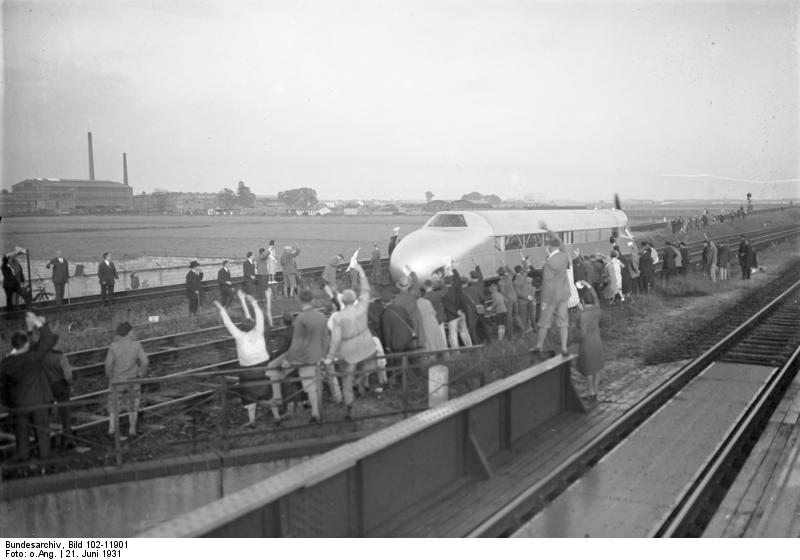
The Rail Zeppelin was
never put into production, but it attracted attention
wherever it went. A BMW airplane engine was used to power a
four-blade wooden propeller that pushed the light-weight
railcar through the air. The construction of the body was
similar to the then-popular Zeppelin airships and the
interior was Spartan; this train was not luxurious.
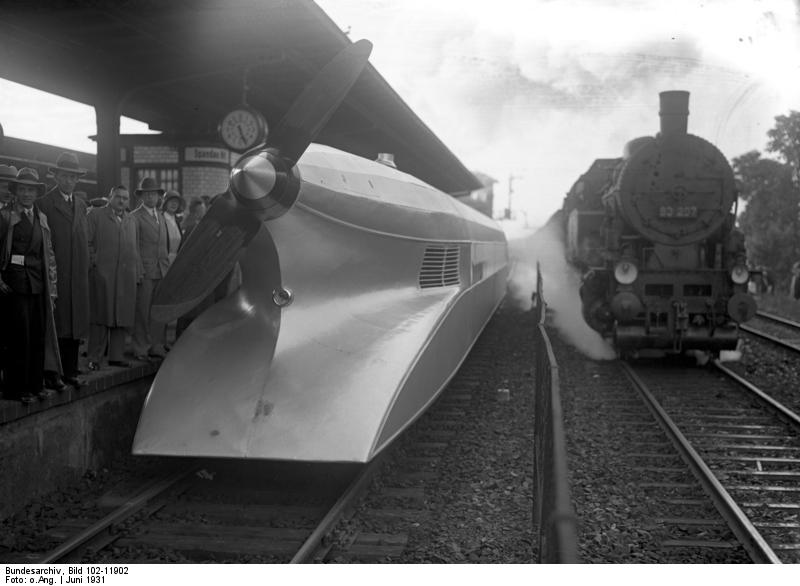
The failure of the
Rail Zeppelin has been attributed to everything from the
dangers of using an open propeller in crowded railway
stations to competition between Kruckenberg's
Flugbahngesellschaft company and the Deutsche Reichsbahn's
separate efforts to build a "Fliegende Zuege". The
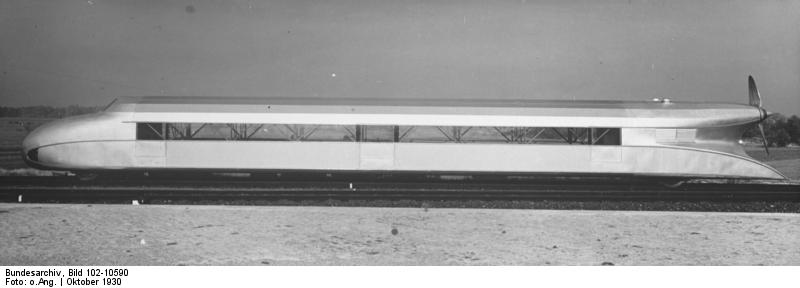
Schienenzeppelin was, however, an important part of the
evolution of high speed passenger rail transport and
continues to attract the attention of railroad fans and
hobbyists.
- - - - - - - - - - - - - - - - - - - - - - - - - - - - -
- - - - - - - - - - - - - - - - - - - - -
- - - - - - - - - - - -
Märklin Rail Zeppelin Models
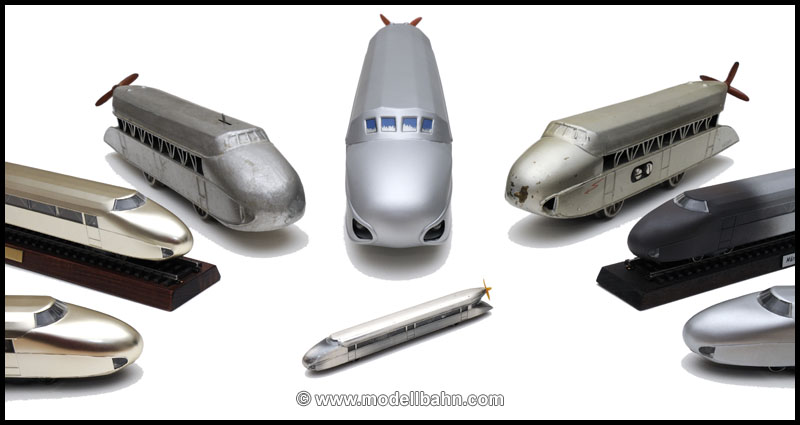
Märklin GmbH, a German company established in 1859, has
been making models of the Rail Zeppelin since 1932. The
variety includes:
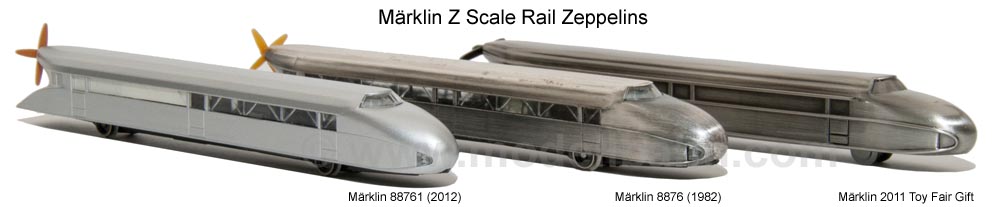
8876 Z-Scale
This is the only Märklin version that is close to the
prototypically correct length. The H0 versions are two
inches too short and have four axles; modifications that
were required to facilitate getting around model railroad
curves that are much too sharp for scale.
The 8876
Z-scale version was issued as a one year item in 1982 to
commemorate the 10th anniversary of Z-scale model
railroading.
88761 Z-Scale
In January 2010, Märklin announced plans to issue another
Z-Scale Rail Zeppelin to commemorate the 175th anniversary
of railroading in Germany. Production of the unit was
delayed until 2012, the 40th anniversary of Z-scale model
railroading. Differences between the 2012
and 1982 versions include:
2011 Nürnberg
International Toy Fair Model Z-Scale
Märklin distributed a
non-motorized version of the 88761 at the Nürnberg
International Toy Fair. This model included
freely-spinning wheels and a rear propeller, but it did not
include see-through windows, interior details, or motors for
the drive gear or propeller.
3077 & 8377 H0
Scale
The 3077 was made from 1975 to 1990. Like the Z-scale
unit, it has a separate motor to power the propeller while
the railcar is propelled by a conventional motor that drives
the two front axles. The 8377 was identical except it was
made for use on two-rail DC systems (vs. the three-rail
system Märklin uses for most of its H0 models).
3477 H0 Scale
The 3477 was issued as a one year item in 1995 to
commemorate the 60th anniversary of H0 scale model
railroading. It is virtually identical to the 3077, except:
-
the 3477 has a
bright finish and interior details
-
the 3477 has a
Delta
circuit that allows it to be used with "conventional"
(analog)
Märklin systems as well as
Digital
Märklin
systems
-
the 3477 has a
silver-plated two-blade propeller (the 3077 has a
plastic four blade propeller)
37777 H0 Scale
In December 2010, Märklin issued an H0 Scale Rail
Zeppelin to commemorate the 175th anniversary of railroading
in Germany. This model has the 3077's matte finish and
the 3477's interior details. It also has an mFX
digital decoder, a sound effects generator, and digitally
controlled interior lighting and propeller.
39777 H0 Scale
In November 2021, Märklin issued an updated version of
the H0 Scale Rail
Zeppelin. This model is the first Märklin H0-scale
model to have a rear red marker light. It also has
improved mFX digital electronics with updated sound effects, digitally
controlled interior lighting & propeller, and
factory-installed figures of an engineer and passengers
SZ970 0-Scale (Clockwork)
The first SZ970 was issued about six months after the
real Rail Zeppelin's record speed run. The SZ970 was powered
by a clockwork mechanism almost identical to that used in
the
clockwork cars, planes, and trucks that Märklin sells today. The SZ970 was sold first sold with a two
blade propeller and then with a four blade propeller. Photos
of the prototype suggest both types of propeller were used
in Kruckenberg's test runs.
SZ12970 0-Scale
(Electric)
The SZ12970 is almost identical to the
SZ970, except that it is powered by an electric motor. It's
likely that it was also first sold with a two-blade prop and
then with a four-blade prop. The four-blade prop unit also
had a red light on the rear of the train.
SZ12971
1-Scale (Electric)
We haven't been able to find much information on this
model, but there is one on display in
Märklin's museum in
Göppingen, Germany.
It's a little more to scale than the 0-gauge unit, which is
very stubby looking. This model may also have been sold as a
clockwork unit, but we haven't seen one.
16075 1-Scale
(Electric)
A replica of the SZ12971 was issued as a limited
production item in 2006. The replica, identified as
catalog number 16075, has the same external appearance as
the SZ12971 but the internal components have been updated to
include a digital decoder and to allow for two-rail
operation. (Click here
for more information.)
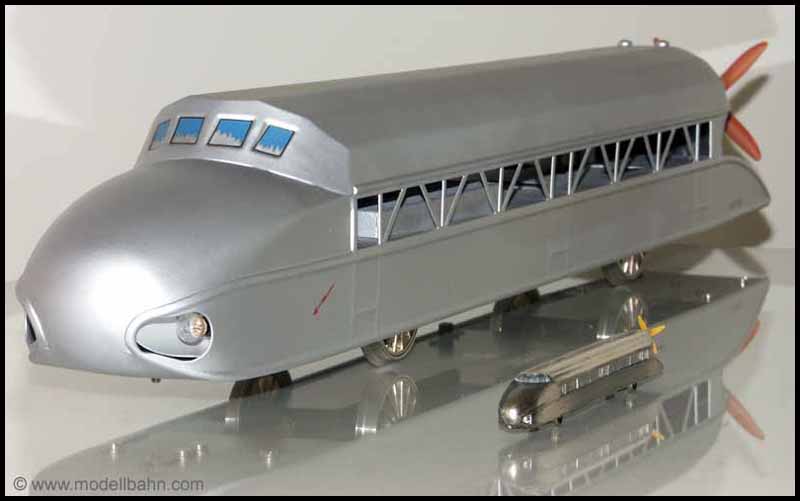
Märklin 16075 (1-Scale) & 8876 (Z-Scale)
Rail Zeppelins
- - - - - - - - - - - - - - - - - - - - - - - - - - - - -
- - - - - - - - - - - -
Collection of Rail Zeppelin Models
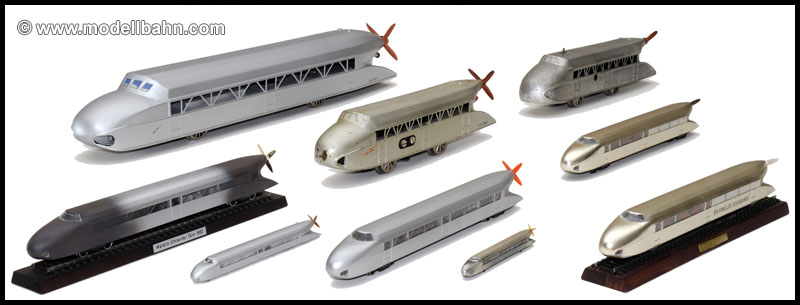
Back Row:
Märklin 16075 - Replica of SZ12971 (1-Scale)
Märklin SZ970 - Clockwork
(0-Scale)
Middle Row:
Märklin SZ971 - Electric (0-Scale)
Märklin 3477 (H0 Scale)
Front Row:
Märklin 3077.82701 - Limited Issue Weathered Version of 3077 (H0
Scale)
KATO/Hobbytrain 2621
(N-Scale)
Märklin 3077 (H0 Scale)
Märklin 8876 (Z-Scale)
Märklin 3477.99701 - Limited Issue Museum/Treff Version of 3477 (H0
Scale)
- - - - - - - - - - - - - - - - - - - - - - - - - - - - - - - - - - - - - - - - - - - - - - - -
- - - - - - - - - - - -
Links to Rail Zeppelin Videos
YouTube has videos showing the prototype Rail Zeppelin as well
as an interesting Kraftwerk music video that combines footage of the
prototype and the Märklin 3077 HO-scale model:
Click below for links to videos of original Rail Zeppelin in action:
Click below for links to videos of Märklin Rail Zeppelins in action:
Click below for a link to a Kraftwerk music video that includes
footage of both the prototype Rail Zeppelin and the Marklin 3077
H0-scale model:
- - - - - - - - - - - - - - - - - - - - - - - - - - - - -
- - - - - - - - - - - - - - - - - - - - - - - - - -
- - - - - - - - - - - -
Zeppelin
(New Technology) Airships
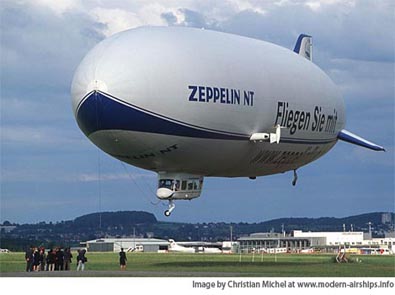
Zeppelin NT, a Neue
Technologie (new technology) Zeppelin is manufactured by
Zeppelin Luftschifftechnik GmbH (ZLT) in Friedrichshafen,
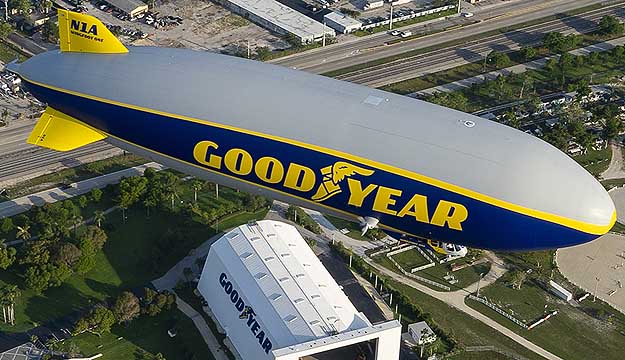
Germany. Zeppelin NTs are now in commercial passenger
(sightseeing) service in
Europe and well as the current generation of GoodYear "Blimps" the United States. Click on the graphics for
more information.
|

